
Staff Stories: Dan Maas
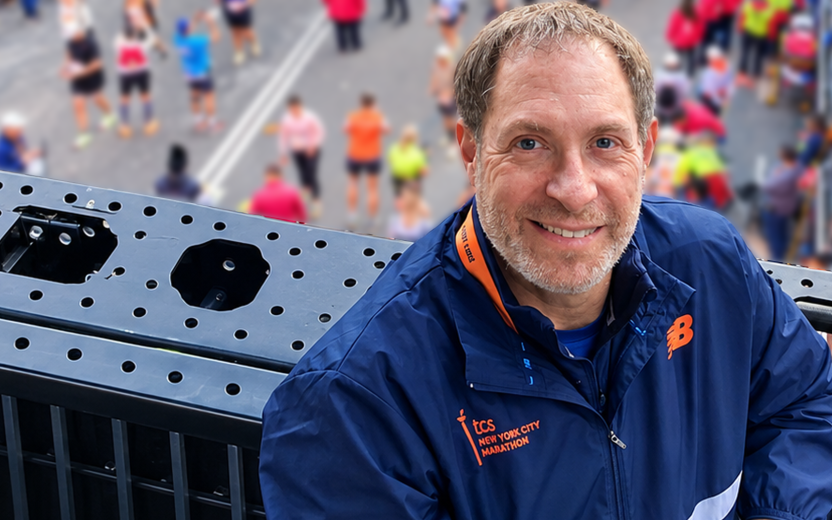
Cornell employee keeps race day running
by Grace DePaull
It’s three o’clock in the morning — the in-between hours that are neither night nor day. Dan Maas is already awake and walking into Central Park. In a few hours, the footfalls of more than 59,000 runners will pound the pavement toward the finish line. But for now, there is only silence — the calm before the storm, and the kind of environment Maas has spent his career training to navigate.
Inside the TCS New York City Marathon’s race-day communications center, that quiet doesn’t last long.
Maas is one of the first to arrive as the day begins to take shape around him. Staff filter in, systems power up, and the stillness of early morning quickly gives way to focused activity. As a part-time Communications Branch Director for New York Road Runners (NYRR), for the United Airlines NYC Half Marathon, the RBC Brooklyn Half and the TCS New York City Marathon, Maas oversees the race-day information network by managing hotline operations, supporting phone operators, and ensuring communication systems are prepared to respond when it matters most.
It’s work that mirrors his role at Cornell.
A graduate of the university, Maas began his career on campus just weeks after earning his degree in agricultural engineering technology in 1987. What started as a position in emergency response evolved into a decades-long career in emergency management, spanning roles in fire protection, event management, and campus-wide preparedness.
Today, as Director of Emergency Management and Business Continuity in Cornell’s Division of Public Safety, he helps the university plan for and respond to a wide range of incidents — from severe weather to major campus events.
“I've always loved exploring the university, and this job gave me the keys to every part of it,” Maas says. “When there’s an issue on campus, our job isn’t to fix it. Instead, it’s about knowing who has the skills and resources to fix it, bringing them together, and making sure they can communicate and collaborate.”
That same philosophy is what first drew him to NYRR.
In 2014, while working at Cornell, Maas responded to a call from NYRR seeking experienced emergency management personnel to support race operations. He jumped at the opportunity to apply his skills in a new setting at one of the world’s largest road races. What began with assisting radio communications and race setup gradually expanded into a more central role. Over time, Maas became a steady presence within the race communications center, helping refine operations, document procedures, and support continuity as systems and teams evolved.
On race day, those years of experience are immediately in play. Maas draws on his background at Cornell — coordinating resources, communicating across multiple teams, and anticipating potential challenges — to help keep the marathon running smoothly. At the same time, the fast-paced environment offers a real-time testing ground for approaches he can bring back to campus.
By 8:00 a.m., the first runners have already begun their journey from Staten Island, crossing the Verrazzano-Narrows Bridge and heading into Brooklyn. Maas and his team are fully engaged—answering calls, troubleshooting systems, and coordinating responses behind the scenes as the race unfolds across the city.
For Maas, working with NYRR offers a chance to apply command, control, and coordination principles in a different environment while continuing to refine the skills he uses at Cornell.
“Every race is different, and there are always unique challenges that require problem solving,” he says. “It’s interesting to see how other organizations and people navigate these challenges and what ideas I can borrow to help improve our operations here at Cornell.”
Whether rerouting runners during a fire on the course, ensuring participants receive the aid they need, or evacuating students during inclement weather on Slope Day, Maas approaches every incident with the same mindset.
“It’s all about testing out the systems that we put in place,” he says. “Identifying problems, making quick decisions, and deploying the right resources to address them. It’s about being creative, troubleshooting, and picking up new solutions along the way.”
As the day stretches on, Maas remains focused inside the communications center but occasionally steps away to catch a glimpse of the race he’s helping support. When he can, he makes his way to the finish line, watching runners cross, sometimes spotting Cornell alumni or familiar faces among the crowd, before returning to his station to continue the work.
By the time the official race clock nears 10:00 p.m., his day is finally done. The communication center and systems are shut down and the equipment has been packed up to be sent back. He steps away for the final time this year, and with some colleagues heads back to the finish line. The last of the marathon’s runners are still making their way across the pavement, determined to complete what they started hours earlier. Volunteers stand ready to celebrate them, medals in hand, their cheers echoing through the quieting streets.
“Seeing those folks out there at 10 o'clock at night is by far my favorite moment,” he reflects. “In this business, we can’t prevent everything. We would love to be able to, and ideally never have any emergency calls or anybody needing medical assistance. Instead, when we can manage incidents quickly and effectively, ensure proper documentation, and learn from what happened — that’s what success really looks like.”
Maas eventually leaves the city behind and begins the journey back to Ithaca, carrying with him the satisfaction of another successful race — and a deeper set of skills and strategies he brings back to Cornell.