
Employee Engagement
We’re not just hiring people, we’re unleashing their potential. Attracting and hiring great employees is critical, but only the first step. Our focus continues through developing, engaging, and retaining people in a way that matches their individual career interests with the needs and priorities of the university.
Video Transcript
1
00:00:01,200 --> 00:00:08,720
Hello everyone, I am Cassie Pierre Joseph, Director for Employee Engagement, and I'm here to share the
2
00:00:08,720 --> 00:00:14,760
plethora of opportunities we have for you and your team to connect with one another and with
3
00:00:14,760 --> 00:00:21,320
colleagues across campus. Here we start with a website through the HR Connection, where you can
4
00:00:21,320 --> 00:00:27,960
learn about opportunities for yourself and your team. One of those opportunities is called the
5
00:00:27,960 --> 00:00:33,200
Colleague Network Groups. The Colleague Network Groups are the University's official employee
6
00:00:33,200 --> 00:00:37,800
resource groups. The university supports the Colleague Network Groups as a way for
7
00:00:37,800 --> 00:00:44,360
traditionally underrepresented populations and their allies to find support and to inform our
8
00:00:44,360 --> 00:00:50,360
campus community and leadership effort. All of this creates and sustains our culture of
9
00:00:50,360 --> 00:00:55,240
inclusion and belonging. The department of inclusion and belonging and the employee
10
00:00:55,240 --> 00:01:02,760
experience teams work together to support their programming. Next we have WAGs, Workforce Affinity
11
00:01:02,760 --> 00:01:09,600
Groups. Workforce Affinity Groups are employee run communities based on interest. Employees
12
00:01:09,600 --> 00:01:16,040
can create a community and connect with fellow employees who share a love and appreciation for
13
00:01:16,040 --> 00:01:24,280
a variety of interests. Such as fishing, gardening, knitting, reading suspense novels, bird watching,
14
00:01:24,280 --> 00:01:31,520
and so much more. It's a great way to find a sense of community within our workforce. Next
15
00:01:31,520 --> 00:01:39,080
we have Cornell Coworker Coffee. Cornell Coworker Coffee is a platform that facilitates connections
16
00:01:39,080 --> 00:01:45,040
between employees. Once someone signs up, it randomly matches them with a new person from
17
00:01:45,040 --> 00:01:51,680
other departments and units from across campus. Matched employees can arrange for a mutually
18
00:01:51,680 --> 00:01:57,440
convenient 15 to 30 minute chat. Coworker Coffee provides fun icebreaker questions
19
00:01:57,440 --> 00:02:03,320
to get you started. If someone can't make their chat for the month, no problem, they can decline and
20
00:02:03,320 --> 00:02:10,920
connect with the next employee the following month. As of now, we have over 257 employees
21
00:02:10,920 --> 00:02:17,160
participating and together. They are connecting to the Cornell mission by learning about areas
22
00:02:17,160 --> 00:02:23,880
beyond their unit or department, discovering new colleague connections and fostering engagement
23
00:02:23,880 --> 00:02:29,400
with colleagues from across the university. People are a significant part of our purpose. This is a
24
00:02:29,400 --> 00:02:35,200
great way to connect to that by introducing them to those upholding the mission on a daily basis
25
00:02:35,200 --> 00:02:42,360
across campus. And finally we have a toolkit for people leaders like you. Meaningful Connections at
26
00:02:42,360 --> 00:02:48,720
work is described as connecting to colleagues authentically and to something significant.
27
00:02:48,720 --> 00:02:55,520
The pandemic accelerated in a re-evaluation of priorities. Employees are asking why they
28
00:02:55,520 --> 00:03:01,160
work for their employer. They want to know that a large portion of their workday, and therefore their
29
00:03:01,160 --> 00:03:08,080
lives, isn't meaningless. People want to experience meaningful connections and connect to a meaningful
30
00:03:08,080 --> 00:03:15,440
purpose. This toolkit provides a framework and resources to support you as a people leader. Use
31
00:03:15,440 --> 00:03:21,120
the tips and the resources for yourself as well as your team. If you have any questions
32
00:03:21,120 --> 00:03:27,920
please feel free to reach out to me; Cassie Pierre Joseph, Director for Employee Engagement.
Employee Lifecycle
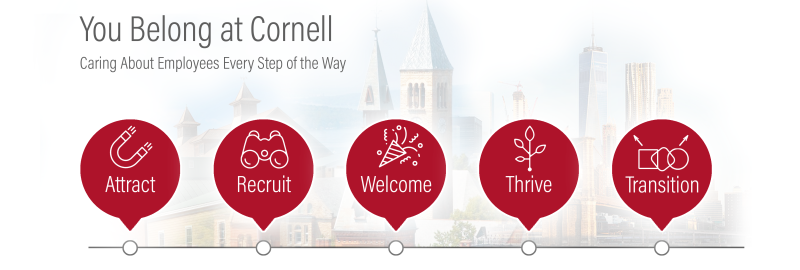
A timeline of the employee experience lifecycle; thrive, recruit, welcome, thrive and transition.
Attract
- We provide generous benefits and opportunities for lifelong learning in a dynamic environment that values inclusion, social responsibility, equity and innovation.
Recruit
- We seek out people with a wide range of talents, abilities and experience, who are excited about working in a community that's changing the world.
Welcome
- We welcome employees to our collaborative workplace culture, building relationships and providing access to resources that support the whole person.
Thrive
- We invest in our employee's career aspirations and development, recognizing their contributions and providing support for wellbeing and the things that matter beyond work.
Transition
- We assist employees as they advance within Cornell, and support their transitions to opportunities elsewhere or into retirement.
Employee Wellbeing at Cornell
Support to help you and your employees thrive at work and beyond. Wellbeing is a multifaceted and continually changing process.
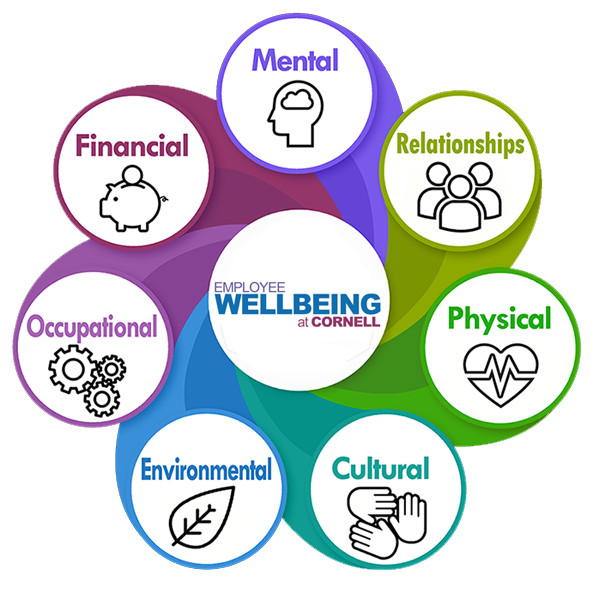
Spiraling circles representing the seven dimensions of Employee Wellbeing at Cornell; mental, relationships, physical, cultural, environmental, occupational and financial.
Explore the Dimensions of Employee Wellbeing at Cornell
Managers Take Five
Got five minutes?
We know that Cornell people leaders have a lot to juggle. That's why we've created the "Managers Take Five" series: quick videos that will update you with the latest support and tips to help you and your staff thrive! Plus handy links to resources for more information.
Each video is just five minutes long and features real Cornell people leaders sharing their expertise. Take a quick break between meetings for some inspiration!
Series Intro
Video Transcript
1
00:00:00,000 --> 00:00:04,560
Hi, i'm Linda Croll Howell, Senior Director of Employee Experience in Cornell's Division
2
00:00:04,560 --> 00:00:10,480
of Human Resources. A couple months ago I was talking to the University Managers Working
3
00:00:10,480 --> 00:00:14,720
Group and they were sharing with me a lot of the challenges that managers at Cornell are
4
00:00:14,720 --> 00:00:21,600
currently facing. This includes smaller candidate pools, higher turnover rates, and employee burnout.
5
00:00:21,600 --> 00:00:27,120
The Manager Take Five series is a series of short videos that talk a little bit about what we've
6
00:00:27,120 --> 00:00:32,080
learned, about what's most important to create a good, positive employee experience all along the
7
00:00:32,080 --> 00:00:37,360
employee life cycle. So the employee life cycle is from the very first time that someone engages
8
00:00:37,360 --> 00:00:42,720
with Cornell through the recruiting process, to when they first start up until when they
9
00:00:42,720 --> 00:00:48,720
actually decide to leave Cornell. And there's some important things that we've learned along the way
10
00:00:48,720 --> 00:00:54,320
that can really help you as a manager with creating the best employee experience. The Take
11
00:00:54,320 --> 00:01:00,320
Five Series is set up to be videos that are five minutes or less, that features some of what we've learned
12
00:01:00,320 --> 00:01:06,320
from our employees. Features a manager who is very skilled in whatever the area is, as well as an HR
13
00:01:06,320 --> 00:01:12,160
expert and some really quick tips that you can put in place immediately. Stay tuned to the Managers
14
00:01:12,160 --> 00:01:25,840
Take Five series, where we'll be talking about hiring, onboarding, thriving, and respectful exits.
Wellbeing
Director of Workforce Wellbeing, Michelle Artibee, talks about Wellbeing with Matt Braun, Assistant Dean, Alumni Affairs and Development at the College of Veterinary Medicine. Matt explains how important wellbeing is to him and his team, and how fostering a culture of wellbeing is beneficial to the workplace.
Video Transcript
1
00:00:00,000 --> 00:00:04,740
[Michelle] Welcome back to the Managers Take 5 series,
I'm Michelle Artibee, Director of Workforce
2
00:00:04,740 --> 00:00:09,000
Wellbeing in the Division of Human Resources at Cornell. During this segment we'll take five
3
00:00:09,000 --> 00:00:13,080
minutes to talk about the importance of a supportive workplace climate, where employees
4
00:00:13,080 --> 00:00:16,980
can thrive. We know that some employees are struggling with things such as the personal
5
00:00:16,980 --> 00:00:21,900
and professional ripple effects of the pandemic, world and national events, feelings of burnout
6
00:00:21,900 --> 00:00:26,880
and fatigue from work-related situations, and pressures and personal life stressors, such
7
00:00:26,880 --> 00:00:32,100
as changes to relationships, finances, elder care, and parenting. Joining me is Matt Braun.
8
00:00:32,100 --> 00:00:36,600
Matt is the Assistant Dean for alumni Affairs and Development in the College of Veterinary
9
00:00:36,600 --> 00:00:43,140
Medicine. Matt welcome and thanks so
much for being here with us.
10
00:00:45,720 --> 00:00:48,120
[Matt] It's a pleasure Michelle, thanks for having me.
11
00:00:48,120 --> 00:00:51,868
[Michelle] Why don't we just get started with what does wellbeing mean to you personally Matt?
12
00:00:51,868 --> 00:00:57,000
[Matt] A center point for me personally
would be, you know, being in a frame of mind where
13
00:00:57,000 --> 00:01:02,880
I'm feeling as present as possible, wherever I am, and being tuned to acknowledge when those
14
00:01:02,880 --> 00:01:09,600
symptoms of wellbeing imbalance creep up in my daily life. So for me, you know, they show up
15
00:01:09,600 --> 00:01:16,860
in the form of a lack of focus or inability
to reflect, impatience, stress, a low morale or
16
00:01:16,860 --> 00:01:20,134
low motivation, maybe feeling bored or burned out.
17
00:01:20,134 --> 00:01:22,809
[Michelle] What does well-being mean to you as a manager Matt?
18
00:01:22,809 --> 00:01:28,920
[Matt] Well at the heart of it, I do my best to support a team climate where everybody feels like they have
19
00:01:28,920 --> 00:01:34,320
the space to take care of themselves and their families. You know, without being able to take
20
00:01:34,320 --> 00:01:39,720
the time to focus on their personal needs, I think the work will suffer. As a manager, I need to be the
21
00:01:39,720 --> 00:01:44,940
cheerleader and I need to be the advocate for a kind social climate promoting group communication
22
00:01:44,940 --> 00:01:51,180
and cohesion. You know, if maintaining a trusting and positive team climate is the glue to workplace
23
00:01:51,180 --> 00:01:56,880
wellbeing then that's what I'm after.
[Michelle] Matt, could you please share two to three things managers can
24
00:01:56,880 --> 00:02:03,000
do right away to prioritize wellbeing in their area?
[Matt] So I think number one we need to demonstrate
25
00:02:03,000 --> 00:02:08,940
and promote a compassionate attitude and, you know, more often than not when you do that you'll be
26
00:02:08,940 --> 00:02:15,000
rewarded with a caring team. Team members, I think, who experience perhaps a hardship in their lives
27
00:02:15,000 --> 00:02:22,500
will find it easier to bounce back into a caring team if that trust exists consistently. Number two
28
00:02:22,500 --> 00:02:27,960
I think, you know, as managers we should be always looking for the pinch points and help people get
29
00:02:27,960 --> 00:02:36,240
unstuck. If we exhibit the grace necessary to put people first, again, will be rewarded by helping,
30
00:02:36,240 --> 00:02:43,140
by seeing them kind of, come out of moments of... of challenge or difficulty. And then I think equally
31
00:02:43,140 --> 00:02:49,080
important is, as managers you know, take care of yourself. If managers aren't feeling centered,
32
00:02:49,080 --> 00:02:54,960
they can't be present for their team. Let the team know when you're not feeling centered
33
00:02:54,960 --> 00:03:00,960
so they know what it looks like when you're off and can reciprocate and provide the feedback you
34
00:03:00,960 --> 00:03:07,601
need to get yourself back on track. For all of us life happens, we need to ask for help.
35
00:03:07,601 --> 00:03:14,160
[Michelle] Do you have any advice for managers who are seeing some
concerning things with individuals on their team
36
00:03:14,160 --> 00:03:19,140
and feel compelled to offer to help but aren't really sure where to start?
[Matt] I think as a manager
37
00:03:19,140 --> 00:03:26,520
I... I do believe we are in a position to acknowledge with our employees individually that we might be
38
00:03:26,520 --> 00:03:33,960
sensing that they're off, for any particular reason, and give them an opportunity to share. Some may
39
00:03:33,960 --> 00:03:41,280
choose to take that opportunity and some may not. But I think the first step to deeper understanding
40
00:03:41,280 --> 00:03:48,060
is to be compassionately inquisitive. We want to make sure that the employee has what they
41
00:03:48,060 --> 00:03:53,220
need to feel good about approaching work on any given day, at any given time. And if you live that,
42
00:03:53,220 --> 00:03:59,940
you know, walk that walk every day, you show up as a manager, it becomes embedded in the culture of your
43
00:03:59,940 --> 00:04:03,826
team, and there's a higher likelihood that people will reach out for help when they need it.
44
00:04:03,826 --> 00:04:08,760
[Michelle] Matt, I really enjoyed talking with you. Thank you so much for sharing your thoughts and ideas, and most
45
00:04:08,760 --> 00:04:14,034
importantly for really striving to create both an effective and a healthy work environment for your team.
46
00:04:14,034 --> 00:04:18,083
[Matt] Thank you Michelle, thanks for having me and initiating this conversation.
47
00:04:18,083 --> 00:04:23,280
[Michelle] Thank you managers for taking five minutes out of your day
to focus on employee well-being. It is critical
48
00:04:23,280 --> 00:04:27,960
to individual and organizational success and we hope the past few minutes have provided
49
00:04:27,960 --> 00:04:35,040
you with some actionable tips that you can start implementing today. Visit hr.cornell.edu/well-being
50
00:04:35,040 --> 00:04:40,567
for information about Cornell services, programs, and policies that support employees.
Respectful Exits
Ensuring a successful and respectable transition out of Cornell can be a delicate matter, but this installment of the Managers Take Five offers some insight to make those exits easier. Nancy Martinsen, Associate Dean of Students and Director of the Asian & Asian American Center, talks with Cassie Pierre Joseph, Director of Workforce Engagement.
Video Transcript
1
00:00:06,120 --> 00:00:12,900
[Cassie] Thank you so much for joining us today, I'm Cassie Pierre Joseph. I lead Engagement Initiatives for
2
00:00:12,900 --> 00:00:19,920
the Employee Experience team within the Division of HR. Today I'm joined by Nancy Martinsen. Hi Nancy!
3
00:00:19,920 --> 00:00:25,680
[Nancy] Hi Cassie, it's good to be here. [Cassie] It's good to have you, please tell us more about yourself.
4
00:00:25,680 --> 00:00:31,620
[Nancy] I am Nancy Martinsen. I'm the Kent G. Sheng, Class of '78, Associate Dean of Students and Director of the
5
00:00:31,620 --> 00:00:36,060
Asian Asian American Center.
[Cassie] Could you share some
of the experience you've had as a manager when
6
00:00:36,060 --> 00:00:42,900
an employee decides to leave?
[Nancy] I recently had to say farewell to my Assistant Director and
7
00:00:42,900 --> 00:00:50,520
I think what was really challenging about that is this um... realization that I understood large
8
00:00:50,520 --> 00:00:57,360
scale what my Assistant Director did, but I didn't know the detailed things that um he did. And so one
9
00:00:57,360 --> 00:01:03,480
of the biggest challenges was recognizing that I still needed to do what I needed to do, and then I
10
00:01:03,480 --> 00:01:09,000
needed to learn all the things that I wasn't aware of in regard to the Assistant Director position.
11
00:01:09,000 --> 00:01:15,240
[Cassie] Wow that's a lot to take on. How did those things impact you?
[Nancy] I think something that's really hard
12
00:01:15,240 --> 00:01:19,860
about when you lose a staff member is is just recognizing the work still needs to get done,
13
00:01:19,860 --> 00:01:25,260
and so it's going to fall on someone. Something that I think is fabulous about the Asian Asian
14
00:01:25,260 --> 00:01:31,920
American Center is that we really do try to have a personal relationship with our interns and one
15
00:01:31,920 --> 00:01:37,140
of the things that my Assistant Director did is, he met with them one-on-one and then he also met
16
00:01:37,140 --> 00:01:43,200
with them as a team and to help them with their projects. Very time consuming but really important.
17
00:01:43,200 --> 00:01:52,020
to the mission of A3C. So I didn't want to take away from the experience. That was really important
18
00:01:52,020 --> 00:01:58,620
for me, for interns to have, but super challenging to now have to recognize that I now needed to be
19
00:01:58,620 --> 00:02:04,020
the one to... to recreate and that experience and to make time for them. [Cassie] Yeah so you talked about
20
00:02:04,020 --> 00:02:09,120
time being a challenge, how are you addressing that challenge and other challenges, and what do
21
00:02:09,120 --> 00:02:15,600
you find works best?
[Nancy] Something for me is, I'm really
big on asking for grace and giving grace. And so I
22
00:02:15,600 --> 00:02:20,880
think just... yeah just kind of recognizing that I'm new with this I'm trying to learn stuff and and
23
00:02:20,880 --> 00:02:25,080
just to ask for grace, and I find for the most part people give it to me. Something that I'm grateful
24
00:02:25,080 --> 00:02:30,720
for is I had a really positive relationship with my co-worker and so um... I was fully aware that he
25
00:02:30,720 --> 00:02:36,240
was looking for a job so it wasn't anything that shocked me or surprised me, like just having that
26
00:02:36,240 --> 00:02:42,660
positive relationship made it easier for me to ask for help from my Assistant Director before they
27
00:02:42,660 --> 00:02:48,780
left. And so one of the things I had asked for was a Transition Doc. and in that transition document
28
00:02:48,780 --> 00:02:53,760
it really was like a step-by-step, like this is how you do these things and then also a timeline
29
00:02:54,540 --> 00:02:56,007
um... 'so heads up Nancy in April
30
00:02:56,007 --> 00:02:58,121
these are the things that you need to start
31
00:02:58,121 --> 00:02:59,220
considering or thinking
32
00:02:59,220 --> 00:03:04,440
about or working on'.
[Cassie] So as you know the resignation
notice period is the last chance we have to make
33
00:03:04,440 --> 00:03:10,020
a positive impression on the employee before they leave Cornell. And that impression could make the
34
00:03:10,020 --> 00:03:12,640
difference between them being a positive ambassador,
35
00:03:13,293 --> 00:03:15,788
meaning that they go out and speak well about
36
00:03:15,788 --> 00:03:17,391
their Cornell experience.
37
00:03:17,735 --> 00:03:22,200
Or they could become a detractor for others that might consider
38
00:03:22,200 --> 00:03:28,020
Cornell, because they've left with a more negative impression. What are some tips you have for fellow
39
00:03:28,020 --> 00:03:34,260
managers that they can start doing right away to ensure a respectful exit experience?
[Nancy] Really looking
40
00:03:34,260 --> 00:03:39,360
back at my experience with my Assistant Director that I'm grateful for, is the honest and open
41
00:03:39,360 --> 00:03:45,540
communication that we had. When it was time for him to depart there was no surprise. I know that
42
00:03:45,540 --> 00:03:51,900
there were certain projects that he was so proud of and so just kind of recognizing like, 'hey these
43
00:03:51,900 --> 00:03:57,480
were some great things, how can I make sure that I'm able to continue it' or 'what information do I
44
00:03:57,480 --> 00:04:02,400
need to pass down to the new Assistant Director so that they can really continue it'. And I did ask him
45
00:04:02,400 --> 00:04:08,100
to write a welcome letter and to the new Assistant Director. I know I got a letter from the former
46
00:04:08,760 --> 00:04:15,000
um Director of A3C, and it was a nice touch. Like it was just kind of a way to... to say like,
47
00:04:15,000 --> 00:04:20,700
'I had a great time in this role and these are some things to be mindful of and these are some things
48
00:04:20,700 --> 00:04:24,982
I really hope you'll enjoy about this position and here's
49
00:04:24,982 --> 00:04:27,053
um my email in case you want to reach out'.
50
00:04:27,053 --> 00:04:28,765
I'm really really grateful for just that...
51
00:04:28,765 --> 00:04:31,136
that positive relationship that we have.
52
00:04:31,136 --> 00:04:32,434
[Cassie] Well thank you so much for
53
00:04:32,434 --> 00:04:38,220
sharing all of your experience with us today on how to create a respectful exit. Thank you
54
00:04:38,220 --> 00:04:42,461
Nancy.
[Nancy] Thank you Cassie for this opportunity, this is fun.
55
00:04:42,461 --> 00:04:45,120
[Cassie] Here are some more tips on respectful exits.
Retention
The key to keeping staff members engaged is to support their development. Here's how one people leader is doing it, plus some other helpful tips to minimize employee turnover.
Maria Wolff, Senior Consultant, Talent Retention chats with Dustin Cutler, Executive Director of Cornell Dining.
Video Transcript
1
00:00:00,000 --> 00:00:04,080
welcome back to the manager Take 5
2
00:00:01,979 --> 00:00:06,180
series I'm Maria Wolf the senior
3
00:00:04,080 --> 00:00:08,040
consultant for talent retention during
4
00:00:06,180 --> 00:00:09,599
this segment we'll take five minutes to
5
00:00:08,040 --> 00:00:11,639
talk about the importance of retaining
6
00:00:09,599 --> 00:00:13,679
talented employees and what you as a
7
00:00:11,639 --> 00:00:15,660
manager can do to proactively address
8
00:00:13,679 --> 00:00:17,580
challenges you may be experiencing in
9
00:00:15,660 --> 00:00:19,920
this area we know people are leaving
10
00:00:17,580 --> 00:00:21,119
Cornell and the top three reasons
11
00:00:19,920 --> 00:00:23,240
include
12
00:00:21,119 --> 00:00:25,859
lack of advancement opportunities
13
00:00:23,240 --> 00:00:27,660
dissatisfaction with their salary and
14
00:00:25,859 --> 00:00:29,760
not receiving enough recognition for the
15
00:00:27,660 --> 00:00:31,380
work they do the goal of this video is
16
00:00:29,760 --> 00:00:33,059
to provide you with some helpful tips
17
00:00:31,380 --> 00:00:35,460
and tools that you can leverage right
18
00:00:33,059 --> 00:00:37,700
away so let's get started
19
00:00:35,460 --> 00:00:37,700
foreign
20
00:00:38,920 --> 00:00:44,399
[Music]
21
00:00:41,960 --> 00:00:46,440
speaking with Dustin Cutler Dustin
22
00:00:44,399 --> 00:00:48,719
welcome and thanks so much for being
23
00:00:46,440 --> 00:00:50,280
here yeah it's my absolute pleasure and
24
00:00:48,719 --> 00:00:52,500
an honor to be here so thank you for the
25
00:00:50,280 --> 00:00:54,120
inviting so the reality is people are
26
00:00:52,500 --> 00:00:55,920
leaving jobs they're leaving jobs
27
00:00:54,120 --> 00:00:57,780
everywhere and hiring managers are
28
00:00:55,920 --> 00:00:58,739
having a really hard time filling vacant
29
00:00:57,780 --> 00:01:00,660
positions
30
00:00:58,739 --> 00:01:03,600
how has this Dynamic impacted your
31
00:01:00,660 --> 00:01:05,220
organization we have hired over 110 new
32
00:01:03,600 --> 00:01:08,939
Frontline Associates here at Cornell
33
00:01:05,220 --> 00:01:11,100
dining and that is a massive effort and
34
00:01:08,939 --> 00:01:13,200
very strategic approach in leveraging
35
00:01:11,100 --> 00:01:15,060
the Partnerships within our our HR
36
00:01:13,200 --> 00:01:17,340
partners and and student and campus life
37
00:01:15,060 --> 00:01:19,500
so what do you focus on when it comes to
38
00:01:17,340 --> 00:01:22,020
being proactive about retention and what
39
00:01:19,500 --> 00:01:23,340
role does Career Development play we got
40
00:01:22,020 --> 00:01:25,740
away from talking a lot about
41
00:01:23,340 --> 00:01:27,900
compensation compensation is very very
42
00:01:25,740 --> 00:01:29,820
important we're explaining really the
43
00:01:27,900 --> 00:01:31,560
why and the benefit of being a Cornell
44
00:01:29,820 --> 00:01:33,360
employee in particular Cornell dining
45
00:01:31,560 --> 00:01:35,159
employee and we have it's yielded us
46
00:01:33,360 --> 00:01:36,720
some some great success with recruiting
47
00:01:35,159 --> 00:01:38,939
as well as allowing people to grow
48
00:01:36,720 --> 00:01:41,400
within the organization so for two years
49
00:01:38,939 --> 00:01:43,860
we're really focused on how to continue
50
00:01:41,400 --> 00:01:45,900
to nourish our team provide them with
51
00:01:43,860 --> 00:01:47,939
the training that they needed and the
52
00:01:45,900 --> 00:01:50,399
tools to make them successful for the
53
00:01:47,939 --> 00:01:52,619
future and that has yielded some some
54
00:01:50,399 --> 00:01:54,960
outstanding results let's talk about
55
00:01:52,619 --> 00:01:56,939
recognition it's so important for people
56
00:01:54,960 --> 00:01:59,399
to feel valued and appreciated for the
57
00:01:56,939 --> 00:02:01,860
work we all do so how do you recognize
58
00:01:59,399 --> 00:02:03,659
people in Cornell Diamond recognition is
59
00:02:01,860 --> 00:02:05,520
so key A couple of years ago my
60
00:02:03,659 --> 00:02:06,899
organization started a program called
61
00:02:05,520 --> 00:02:08,340
The Big Red Apple and some of you may
62
00:02:06,899 --> 00:02:10,380
have seen that around campus as you go
63
00:02:08,340 --> 00:02:12,660
into our locations there's a really big
64
00:02:10,380 --> 00:02:14,459
tree and individuals recognize one
65
00:02:12,660 --> 00:02:16,560
another and that's really been a core
66
00:02:14,459 --> 00:02:18,060
value of our organization and the key to
67
00:02:16,560 --> 00:02:20,280
our success of letting people know Hey
68
00:02:18,060 --> 00:02:22,319
listen we care about you we care about
69
00:02:20,280 --> 00:02:25,500
your impact we care about your career
70
00:02:22,319 --> 00:02:27,420
over I think 10 000 recognitions have
71
00:02:25,500 --> 00:02:29,700
happened over the past five years so
72
00:02:27,420 --> 00:02:31,860
we're very proud about that and and it's
73
00:02:29,700 --> 00:02:33,120
yielded some great results it's pretty
74
00:02:31,860 --> 00:02:34,860
clear that we are caring and
75
00:02:33,120 --> 00:02:36,959
compassionate leader is a priority for
76
00:02:34,860 --> 00:02:39,239
you so how does your leadership style
77
00:02:36,959 --> 00:02:41,459
help keep your staff engaged and wanting
78
00:02:39,239 --> 00:02:43,260
to stay at Cornell quite frequently we
79
00:02:41,459 --> 00:02:45,720
really explain to our Frontline staff
80
00:02:43,260 --> 00:02:46,680
and our management team our why in our
81
00:02:45,720 --> 00:02:48,660
purpose
82
00:02:46,680 --> 00:02:51,120
it's very important for people to be
83
00:02:48,660 --> 00:02:53,819
able to connect what I am doing what
84
00:02:51,120 --> 00:02:56,040
that impact is to the our community and
85
00:02:53,819 --> 00:02:58,019
the individuals that we serve and it's
86
00:02:56,040 --> 00:02:59,879
very important to simplify that agenda
87
00:02:58,019 --> 00:03:02,459
like our purpose statement is nourishing
88
00:02:59,879 --> 00:03:03,780
the future our staff knows that our
89
00:03:02,459 --> 00:03:05,700
training and development efforts are to
90
00:03:03,780 --> 00:03:07,980
help nourish their their minds and and
91
00:03:05,700 --> 00:03:10,440
allow them to grow the food that we make
92
00:03:07,980 --> 00:03:12,420
helps nourish the people's bodies that
93
00:03:10,440 --> 00:03:14,819
we feed on a regular basis right so
94
00:03:12,420 --> 00:03:16,920
being able to connect that why is very
95
00:03:14,819 --> 00:03:19,440
important you want individuals to come
96
00:03:16,920 --> 00:03:21,599
to work because they know their why they
97
00:03:19,440 --> 00:03:23,480
understand what their purpose is
98
00:03:21,599 --> 00:03:27,060
it's important to be a servant leader
99
00:03:23,480 --> 00:03:29,400
and making sure that people can really
100
00:03:27,060 --> 00:03:32,640
connect to why I come to work
101
00:03:29,400 --> 00:03:33,739
what is the impact and building a sense
102
00:03:32,640 --> 00:03:36,239
of community
103
00:03:33,739 --> 00:03:37,860
amongst your group that is what really
104
00:03:36,239 --> 00:03:40,260
builds a great culture that propels
105
00:03:37,860 --> 00:03:42,540
success thank you so much for sharing
106
00:03:40,260 --> 00:03:45,060
all that as we come to the end of our
107
00:03:42,540 --> 00:03:46,860
conversation would you mind just sharing
108
00:03:45,060 --> 00:03:49,140
two to three tips managers can leverage
109
00:03:46,860 --> 00:03:50,519
right away the three tips that I would
110
00:03:49,140 --> 00:03:52,500
give in areas that I would say has
111
00:03:50,519 --> 00:03:55,159
worked for Cornell dining and myself is
112
00:03:52,500 --> 00:03:58,980
to focus on authentic communication
113
00:03:55,159 --> 00:04:01,920
recognition and servant leadership and
114
00:03:58,980 --> 00:04:04,019
when I say communication try as much as
115
00:04:01,920 --> 00:04:06,900
possible to get in front of human beings
116
00:04:04,019 --> 00:04:09,299
face to face be present when I say
117
00:04:06,900 --> 00:04:11,459
recognition do it frequently do it
118
00:04:09,299 --> 00:04:13,560
consistently and again allow it to be
119
00:04:11,459 --> 00:04:15,360
authentic when I talk about servant
120
00:04:13,560 --> 00:04:17,220
leadership this is where I say that
121
00:04:15,360 --> 00:04:20,100
individuals need to look at
122
00:04:17,220 --> 00:04:22,079
leadership in the sense of it's an honor
123
00:04:20,100 --> 00:04:25,740
to be able to lead an organization to
124
00:04:22,079 --> 00:04:28,320
give guidance and make sure that you are
125
00:04:25,740 --> 00:04:30,419
seeking to understand before being
126
00:04:28,320 --> 00:04:31,800
understood I often say that best
127
00:04:30,419 --> 00:04:33,840
communicators are the most effective
128
00:04:31,800 --> 00:04:35,940
listeners and I think a lot of people
129
00:04:33,840 --> 00:04:38,220
during these times need to do a lot of
130
00:04:35,940 --> 00:04:40,699
listening Dustin I really enjoyed
131
00:04:38,220 --> 00:04:40,699
talking with you
132
00:04:42,300 --> 00:04:47,040
so much for the opportunity my pleasure
133
00:04:44,820 --> 00:04:48,660
thanks Cornell dining we hope the past
134
00:04:47,040 --> 00:04:50,280
few minutes have provided you with some
135
00:04:48,660 --> 00:04:52,020
actionable tips to implement today
136
00:04:50,280 --> 00:04:53,580
please check out these additional
137
00:04:52,020 --> 00:04:55,759
resources
138
00:04:53,580 --> 00:04:55,759
thank you
Career Development
At Cornell, we believe that career management is an 80-10-10 split between the employee, the university, and you, their manager.
Coaching
Coaching is one of the most effective tools available to take leadership development to a deeper and more sustainable level.
Flexibility
The most effective teams are adaptive to challenges and flexible enough to make changes to the workplace when the need arises.
Performance
The development of staff is a shared responsibility of individual staff members, people leaders, and the university leadership.
Recognition
Recognition of an employee or team can make anyone feel appreciated and be a major boost to overall morale.
Inclusion
When employees feel a sense of belonging at work, they can bring their best selves.